Showing posts with label Palestine. Show all posts

Sunday, 19 July 2015

Hebron - A ghost town

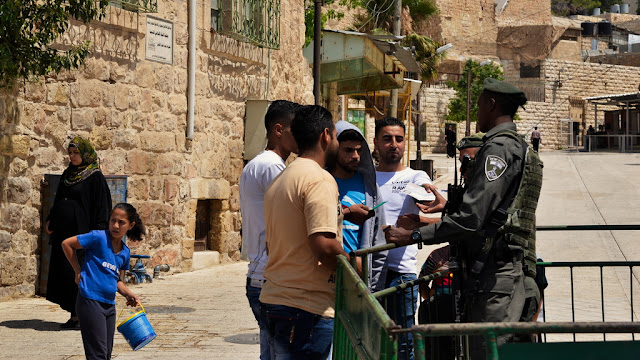
Soldiers inspect ID cards of local Palestinians at the entrance to the Cave of the Patriarchs
Four Palestinian youth approach two armed guards stationed outside the Cave of the Patriarchs, they set their bags down, one seems to be carrying groceries, they queue up, reach for their ID cards and hold them out for inspection. The guards carefully scrutinise the cards and only then let them enter. A few feet away, at what looks like the main entrance to the holy site, tourist buses come to a halt, pilgrims and visitors disembark leisurely and head towards the main building and there are no visible guards who restrict entry for them.

There are no obvious lines here but you can feel the dense languor of imprisonment in the air. Palestinians can walk down the street to only up to a certain point, the path beyond that is off-limits to Palestinian pedestrians and vehicles. I had read about Hebron before visiting the city and yet, it is only when I saw Palestinians walk down a road and take a diversion while I continued to walk down that very street which was off-limits to them that I understood what apartheid meant.

Welcome to Hebron, a microcosm of the Israel-Palestine conflict.

Anatomy of a Ghost Town
I have used the phrase Ghost Town many times in life, all those times it has been only as an over-dramatisation. Mass abandonment of Hebron's city centre since the second Intifada has created a literal Ghost Town here. Strict implementation of a separation and discrimination policy between Israeli settlers and Palestinians has driven Palestinians out of their homes. The claim is that Israeli settlers need protection and the army follows them where they go. This results in heavy restrictions on the movement of Palestinian residents creating what the military calls 'sterile' zones or areas that are rid of Palestinians.
Al-Shuhada Street, once a vibrant market street
Al-Shuhada street was once a bustling market street in the Old City of Hebron. The monotony of the skeletal visage of this street is now interrupted only by Israeli settlers. We cross the army check-post after two armed guards inspect our passports. Houses abandoned by Palestinians stand amidst their crumbling ruins. One of the houses is still occupied, the soldiers call the family residing here 'the mute family', because the family doesn't speak to anyone. Why have they not left their home? Because they can't afford to relocate.
A shop shutter defaced by the star of David
The shop shutters here are defaced by graffiti. Maybe some obscenities that the foreign eye cannot spot, but more importantly an image that is just enough to irk the Palestinians and to send a message to everyone who walks past these shops : the six-pointed star of David. The blue star of David against faded green shutters is an image that reeks of a sense of entitlement and legitimacy that is a product of military occupation. The graffiti becomes more prominent and frequent on streets that are open to Palestinian pedestrians and vehicles.
Call for attention on Al-Shuhada Street
The eerie silence on the street is suddenly broken. I look up, on the other side of a caged window,two young children are bickering, they look at us. I am not sure if I should wave, but I look up and smile anyway. The mother soon removes the children from the window, the shrill screams of the children fade away and we are back to discussing the grim reality of Hebron. Windows and balconies here are heavily grilled to protect Palestinians from settler violence. On one such balcony is a small sign, it reads: CAUTION: This was taken by Israel. You are ____ apartheid.
Sign on a street. In the background is a settler building.
Al-Shuhada street is now a gallery of settler propaganda on the backdrop of the outcome of military occupation. A large sign installed on the road by what looks like the Hebron civic authorities reads: These stores were closed by the IDF for security reasons after the Arabs started the 'Oslo War' (aka The Second Intifada) in 2000, attacking, murdering and wounding Jews on this road. Another goes on to state that 'after the Hebron Agreement was signed, Jews were left with access to only three percent of Hebron and that large thriving commercial and shopping centres are off-limits to Jew and accessible only to Arabs'. To understand the accuracy of this estimate, it is important to recognise everything that comes with a settlement.

Settlements in Hebron
A settlement in the Old City, a part of H2. Cars with Israeli license plates parked on the street.
Israeli flags flutter above shops that are shut
While it is true that settlers homes may be occupying only three percent of Hebron, nearly 20 percent of the city is off-limits to the Palestinians. This 20 percent constitutes various legal, military and administrative rationale exacting limitations on the local residents. For example, around every settlement is a buffer zone that separates the settlers from their Arab neighbours. Settlements are also increasingly eating into Hebron by constantly creating new settlement 'outposts'. These outposts sometimes explicitly defy the Israeli Supreme Court's orders. As they incrementally solidify their presence over what is most often private Palestinian land, the Israeli Government gives in and 'legalises' settlements.
Map of Hebron with restrictions on movement. Source: B'Tselem
Given its significance, the main impetus to live in Hebron is religious, centered around the Cave of the Patriarchs. Settlement outposts here constantly attempt to create a mainline to the holy site. They are also driven by the same 'right of return' for which many Palestine refugees wish. Alluding to the 1929 Hebron massacre, following which homes of Jews were pillaged, settlers demand the right to return to Hebron. Despite the original owners of the abandoned Jewish homes showing no inclination to return, settlers have made it their agenda to take back these areas and houses.

The total population of four settlements in the Old City of Hebron (in H2) is around 800, to protect them the military has deployed more than 500 armed soldiers. About 30,000 Palestinians also live in H2 which is under direct Israeli rule. The Hebron civic authority responds to this disproportionate military presence on its website, it says :

Israeli security forces provide multiple services.
a) They offer protection to Hebron's residents against constant terror threats.
b) They offer protection to over half a million people who visit Hebron annually.
c) They offer protection to Israelis throughout Israel.

Hebron's story is defined by the social dynamic created by the heavy presence of military in an urban area which is slowing being chipped away by a strict separation policy and settler invasion. Beginning with this post and few more I hope to make a comprehensive note on my experience and learning from a visit to Hebron. 

Thursday, 2 July 2015

Notes from a Palestine Refugee Camp

Balata Refugee Camp : 0.25 sqkm, 28,000 refugees and 65 years of temporary residency

When a refugee camp has been functioning for 65 years, it sheds its temporary appearance and dons a more long-term garb. And that is what makes the fate of the refugee camps in the Palestinian Territories a central point of contention to the Israel-Palestine conflict.

In Nablus, the Balata Refugee camp could be easily mistaken for a congested poverty-stricken neighbourhood. The transition between suburban Nablus and the camp is seamless and a non-local could walk around or cross the camp without once realising that one has passed by the largest refugee camp in the West Bank. When we got off at Jacob's Well (our first stop), we looked around hoping to find signs to Balata Camp as that was our next stop. A local then pointed to a cluster of buildings across the road, "That's Balata Camp." I have never been to a refugee camp earlier, but I surely did not expect it to be integrated into the suburbs of a city with such proximity to a site of Biblical importance.

A refugee at the Balata Camp
Many of the Balata Camp refugees are from Jaffa, a neighbourhood to the south of Tel Aviv. The passing of time has not diluted the desire of the refugees to the villages from where their ancestors either fled or were expelled. In fact, the right of return to their original town or village is at the core of the conflict here. Families still hold keys to their homes which are now either destroyed or are being used by other families, as a reminder of their lost homes. Some families get the chance to visit their villages. These pilgrimages come by rarely because refugees need permits to enter Israel and also because many refugees are too poor to take up such a journey. When families do get the chance, stories of the pilgrimages become the only window for many to their lost lost ancestral villages. "One family found their house in Jaffa and even paid a visit to the Jewish family living there. My family on the other hand could not even recognise our neighbourhood in Haifa. We still hold the keys but our house has been destroyed," A narrates.

These symbols are what keep the hope of return alive in them. Although first or second generation refugees still cling on to symbols of home and harbour the hope of return, children who have been brought up in the refugee camp have a kind of an identity crisis. While they mostly identify with Balata, their fondness for their village is no less. "We may be brought up in Balata or Nablus, but we should never forget the village to which we belong. Our ancestors tell us about their life back in their village just so we remember..." says A.

A child cleans the area in front of
his home
Refugees in the Balata Camp are in their fifth generation. According to the UNRWA "The descendants of Palestine refugee males, including legally adopted children, are also eligible for registration." This is a special status given to Palestine Refugees. This move of the UNRWA is well-contended and that is a debate currently beyond my scope. That said, there is no denying the humanitarian crisis of Balata's 28,000 refugees and more than 7.5 lakh registered UNRWA refugees.

According to UN data, in 2008 there were more than 1,700 houses with one or more upper floors housing the 23,000-odd refugees. One can only imagine what the living conditions of the refugees must be like. As families grow, more floors are added to the building to accommodate the family. This translates into claustrophobic alleyways which receive very less sunlight even during the day. "The homes at the lower levels receive very little sunlight and ventilation is a problem too," states A. As I walk through these narrow lanes with my backpack grazing against the walls, I am flooded with questions. How does one bring furniture in? How do the handicapped access their homes? What if some one needs to be taken to the hospital in an ambulance? We carry the people, A says very matter of fact-ly. The Balata Camp is a self-sufficient ecosystem replete with a comprehensive market streets that cuts through the camp offering some breathing space to the cramped layout.

The market or souk in the Balata Refugee Camp
Children across Nablus and Balata greet foreigners with "Hi! How do you?" It is as if they are testing you. When responded to, they are confident in replying, "I am good, thank you." Many even want their photos to be clicked and have a friendly disposition. One little guy with a sense of humour came up to us and said: My name is Hassan in Arabic and Hassan in English. A camera in hand, and a smile on your lips invites curious interactions with children here. Four UN schools cater to the children of Balata Camp. There are many who don't make it to school, and there begins the problem.

Balata Camp is a microcosm of the general problems refugees face here. High unemployment rates with a high youth population make the right brew for violent outbreaks. In 2007, 40.1 percent of Balata Camp's population was under 14 years of age. Families mostly turn children into bread-winners to fight poverty. Adults find it difficult to find jobs as the Israeli market is not accessible to them. Balata is a breeding ground for anti-social and violent youth who take up arms to make their voices heard. Posters of civilian fighters brandishing weapons are more frequent here than in the Old City of Nablus. Are they justified in their violence? Who must compromise more? Is a solution in sight? As a mere visitor I cannot comprehend what kind of a solution could be drawn up to put an end to the kind of human suffering I witnessed here. A step towards that is this little post. I urge you to read more, because I have just scraped the tip of the iceberg here. There is much to learn and much to do.   

Monday, 22 June 2015

Nablus: First impressions of Palestine

Last week I ventured into the West Bank or as I prefer to call it Palestine. It seems a unfair to refer to it as the West Bank when India and 135 other countries recognise Palestine as a state. Honestly, more than six months in this country has made me more sensitive to such nomenclature, the communities involved and their perspectives in general.

Seething with rage
Nablus is the third largest city in the Palestinian Territories after Gaza City and Hebron. It is located about 130km east of Tel Aviv and can be reached from Tel Aviv in about 90 minutes. I am not an authority on what route to take to get there, although an Arab cab driver from East Jerusalem is whom you should hire if you plan a trip to any of the Palestinian Territories. 

The drive to Nablus was event-less. I was expecting to be stopped at a check-post and asked for my passport and questioned on my purpose of visit etc, but that was not the case. Although you cross the Green Line without any inkling of having crossed one of the most disputed borders in the world, leaving Israeli territory and entering Palestinian territory is dramatic. When the Isareli roads do not let you feel the jolt, the Judean Hills loom over making you take notice of the transition. 

It was during the drive from Jerusalem to Masada/Dead Sea that I first saw The Wall and felt the sharp change in geography and demography. Clotheslines with white shirts and black pants disappeared and were replaced by barbed wire restricting Palestinians access to the 'Israeli' highway; residential buildings faded away and the dry and rocky Judean Hills took their place along the roads. The drive to Nablus was similar. Unless you stay awake and look out of the window, when you reach the shock will come to you as a punch in your gut. The scenery eases the transition. 

Nablus is one of the eight cities that is classified under Area A, meaning it is completly under Palestinian control, barring nearby settlements of course. The sights and sounds of Nablus' city centre reminded me of busy a Indian city or even East Jerusalem for that matter. Making me feel more at home in this Palestinian city were huge hoardings of Shah Rukh Khan, Aishwarya Rai and Emran Hashmi promoting cosmetics. The city centre is lined with shopping complexes, eateries, banks and everything else a modern city centre constitutes. Tall modern shopping complexes that dominate the city's skyline here are just a modern facade of the old city of Nablus itself.

SRK promoting fairness
cream in Palestine
Negotiating random traffic which comprised mules and Volkswagens alike, we entered a narrow covered market street. Everything about the market street reminded me of Jerusalem's old city. The arches, the colour of the walls, the meditative azaan, colourful and aromatic spices on display and even the carts that shopkeepers use to transport goods inside the old city. After a short walk through the old city's market we entered the maze of Nablus' old city.

Nablus City Centre                     Nablus Old City
The old city of Nablus is similar to that of Jerusalem in many ways and is radically different is an equal number of ways. The political graffiti calling for a united Palestine, posters of civilian fighters brandishing weapons and plaques on houses with photos of family members who were either martyrs or victims of Israeli military form the main narrative here. Locals point to particular windows and houses and retell how Israeli military holed up in those houses shot and killed innocent civilians. The old city was under siege by the Israeli military as part of Operation Defensive Shield in 2002. During this time strict curfew was imposed on the old city residents and the military entered many houses by boring holes in walls. The curfew lasted more than three months. A who was in his late teens during this period says, "We did not have enough supplies to last so many days. People who broke curfew to procure food and water were gunned down by snipers." From a roof top a local points to a vacant space that looks like a parking lot inside the old city, "There used to be a soap factory here. The military suspected that terrorists were hiding in there and brought the building down. It later turned out that just a small Palestinian family was living there."

Left: Call for Action; Right Top: Civilian fighter brandishing weapon
Right Bottom: Plaque for martyrs and victims
In its days of glory, Nablus was a business centre famous for its soaps made from olive oil. The city's economy sustained a huge blow with the Israeli occupation of Palestine. The number of soap factories has dwindled over the years and only two or three are still functional. If you are lucky to visit the city at the right time of the day, you could visit a soap factory inside the old city. 

If you peel away the layers of violence that the old city has sustained and witnessed as recently as the second Intifada (200-2005), you would be able to uncover the charm and majesty of this historical city. Standing on one of the roof tops, I see the old crumbling old city buildings against the backdrop of the modern houses built on the hills surrounding the city. Those who could afford to leave their houses in the old city for new houses have done so, turning the old city into a magnificent time capsule. 
New construction on the hills surrounding the Old City 
The market of Nablus' old city is one where I finally bought kajal as I was running out of my desi supply. The market here is most famous for the best kanafeh in all of Palestine. A nondescript hole in the wall bakery is one of the many bakeries here that make the most tasty Middle-Eastern dessert I have tasted so far. Two workers pass huge circular trays around spreading semolina and cheese, the key ingredients of kanafeh, on the trays. A third takes it to the kitchen to cook it  
Kanafeh from start to finish
and a fourth is busy crumbling big blocks of white Nablusi cheese into small pieces. With an indulgent slathering of sugar syrup, the rust-coloured gooey kanafeh is ready. A queue has formed in the meantime, the previous batch of customers are getting ready to leave and make space for the next batch. It took less than ten minutes for the rather large tray of kanafeh to be served to around 30 eager customers. The dessert is juicy, cheesy, and even has a little crunch to it because of the upper crust of semolina. A generous chunk of the dessert cost me just 4 shekels! I don't even get a bar of chocolate for 4 shekels in Tel Aviv! 

Jacob's Well
Entry to Nablus is forbidden for Israelis; if you own a non-Israeli passport there is no reason you should miss a short day trip to Nablus. It is easy to visit to Nablus, just hop on to a taxi from East Jerusalem near Damascus Gate. The city also has a couple of non-political spots of interest. Tel Balata is an archealogical site where excavators have found the remains a massive Cannaite city wall (1700 BC) and a temple. Jacob's Well is not far from Tell Balata. Go inside and take a sip of water from the well where Jesus is said to have had water offered by a Samaritan woman. The well is inside an Greek Orthodox Monastery. A lone priest is the sole keeper of this Biblical site.